
Buying Guides / The notebook
Decide Whether You Need to Buy Anything
Turn a healthy-aging shopping idea into a practical decision: define the task, check what you already own and compare total costs before ordering.
By Anti-Aging · Published
We may earn a commission from qualifying purchases. Affiliate disclosure
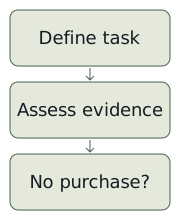
Give the purchase one job
Before setting a budget, finish this sentence: “I would use this to ___, and I would know it helped my routine if ___.” Recording a measurement, reading a display more easily and reducing an annoying setup step are concrete jobs. Buying “longevity” is not a specification that a checkout page can satisfy.
Keep healthcare decisions separate from the shopping exercise. NIA advises discussing supplements with a doctor before using them to address a health condition and notes that evidence of benefit is limited for many products. A plausible product description is not a personal reason to take an ingredient. NIA supplement information.
Start with what you already have
Make an inventory before making a shortlist. Write down the exact device or supplies you own, what still works and the specific limitation that makes you consider replacing them. Check whether that limitation is actually a missing feature, a fit problem, an unread instruction or a task you no longer need to perform.
Use three possible next steps:
- Keep: the existing item does the defined job and you have no identified reason to replace it.
- Investigate: a requirement is unclear; check the manual or ask an appropriate professional before spending.
- Replace: you can name the unmet requirement and compare alternatives against it.
These are budgeting prompts, not instructions to keep using a damaged device or to postpone necessary care.
Do not confuse convenience with the underlying purpose
For home blood-pressure recording, AHA recommends a validated upper-arm monitor, an appropriate cuff and correct technique. It advises discussing use with a healthcare professional and bringing the monitor to an appointment. App features do not replace those checks. AHA home-monitoring guidance.
A simple written record may meet your record-keeping need; a connected system may instead save a step you genuinely struggle with. Decide which problem you are solving before assigning a value to automatic syncing. Do not pay for an account feature merely because it appears in a longer comparison table.
Compare ownership costs on paper
List the initial item, required accessories, replacement supplies, batteries or charging needs and any optional recurring service separately. Mark a cost unknown when you cannot establish it. An unexplained blank is not zero.
For a fictional example, Item A costs $40 and optional service costs $5 monthly. Item B costs $70 without that service. If you choose twelve months of the service, A costs $100 before other supplies; B costs $70. That arithmetic does not establish that B is better, that the products are equivalent or that either is needed. It simply makes one chosen expense visible.
Make a no-purchase decision usable
Write a short decision note: the task, what you will use now, what fact remains unresolved and what would justify revisiting the purchase. “Wait until I know the required cuff size” is more useful than an indefinite shopping list.
When symptoms, treatment or supplement interactions are the reason you started shopping, the next step may be qualified advice, not another product comparison. A sound purchase decision can end with keeping your money and clarifying the question.
Further reading
Check the exact source and product details when you spot a discrepancy.