
Buying Guides / The notebook
Read a Longevity Claim Without Skipping the Evidence
Separate human outcomes, laboratory findings and surrogate measurements before deciding what a longevity headline means for a purchase.
By Anti-Aging · Published
We may earn a commission from qualifying purchases. Affiliate disclosure
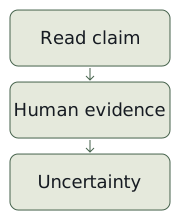
Turn the headline into a question
A useful first question is not “does this sound scientific?” It is “what changed, in whom, over what period, compared with what?” Keep that sentence beside the purchase claim. If the article describes a laboratory measurement but the advertisement promises more healthy years, the missing connection is the part to investigate.
Do not treat lifespan and healthspan as interchangeable promises. The aging-biomarker review distinguishes lifespan from healthy functioning and discusses the difficulty of evaluating interventions through suitable measurements. A result about one endpoint is not automatically a result about the other. Biomarkers of aging review.
Identify the study before reading the sales conclusion
Write a short evidence card with these fields:
- Population: cells, animals or people; and which people.
- Intervention: exact ingredient, product, activity or procedure.
- Comparator: what the intervention was compared with.
- Duration: how long the participants or experimental subjects were followed.
- Outcome: what the investigators actually measured.
- Applicability: what would need to match for the result to inform your decision.
A blank field is a reason to read further, not a space to fill from the advertisement. Distinguish an intervention study from an observation of people who already choose a particular behavior. The latter leaves different questions about what explains a relationship.
Do not promote a measurement into a proven benefit
A biomarker can be useful for research without establishing that buying a product will extend life. The review treats biomarker selection and validation as central challenges in evaluating longevity interventions. Before accepting a surrogate endpoint, ask what evidence connects a change in that marker with the outcome the seller promises. Biomarker review.
NIA’s discussion of calorie-restriction mimetics illustrates a separate translation problem: promising laboratory and animal work does not itself establish an effective anti-aging purchase for healthy people. Its account describes different responses across compounds and animal experiments rather than a universal consumer answer. NIA research explainer.
A fictional example of the missing bridge
Imagine an advertisement saying that fictional Ingredient X “supports a younger future.” The linked experiment instead follows a laboratory marker for six weeks. Even if the reported change is real, the purchase question still has several missing fields: whether people lived longer or functioned better, whether harms were assessed, and whether the store product matches the experimental formulation.
This is an illustration, not a description of an actual trial or ingredient. The point is to keep the measured outcome in your notes without rewriting it into the outcome you hoped to see.
Choose the next step before choosing the product
Save the study title and the claim you want checked. Ask whether the research is relevant to your age, health circumstances and intended use, and whether a clinician or pharmacist should help interpret it. A practical device may still be useful for recording a measurement without proving that it slows aging; keep those decisions separate.
The strongest conclusion your notes support may be “interesting research, no purchase decision yet.” That is a complete decision, not a failure to understand the science. This guide helps you read claims; it does not prescribe an intervention or replace individual medical advice.
Further reading
Check the exact source and product details when you spot a discrepancy.